
Why Landlords Rely on the 1031 Exchange
Why Landlords Rely on the 1031 Exchange
Annually, landlords relinquish thousands of dollars that could legally be tax-deferred through 1031 exchanges. In fact, 1031 exchanges represent more than $13.2 billion worth of annual tax deferrals in the US alone. In case you possess investment property and have not made use of a 1031 exchange, you could be discarding a considerable amount of money.
What Is a 1031 Exchange, Actually?
The 1031 exchange is based on Section 1031 of the IRS tax code. It enables you to sell an investment property and then invest all the proceeds into another qualifying property without incurring capital gains tax at the time of the sale. You could even say that the government is giving you an interest-free loan on your tax bill as long as you keep reinvesting.
How is a like-kind property defined?
The standard is actually looser than what most people expect. You may exchange:
A single-family rental for a commercial building
An apartment block for a strip mall
One property for several replacement properties
A property in one state for one in a totally different location
Primary residences and properties mainly used for resale are not eligible.
What Makes Serious Landlords Rely on It?
Deferral of taxes is only the beginning. In fact, it's this element that makes the 1031 exchange a truly powerful wealth-building strategy. First of all, you keep your entire equity at work.
Normally, when you sell without using a 1031 exchange, the combination of capital gains tax and depreciation recapture can reduce your proceeds by 35% or even more. However, if an exchange is properly structured, all your money goes towards your next property. Having more equity means getting better loan terms and a higher-value asset right from the start.
Besides, you can remodel your entire portfolio.
Landlords leverage the 1031 exchange to change the shape of their portfolios, upgrade, diversify, or consolidate. Here's what they typically do:
Moving out of a slow-appreciation market into a more robust one
Changing from several smaller properties to one asset, which is easier to manage
Going for a type of property that produces more cash flow
Besides, you can reshape your entire portfolio.
There are no restrictions on the times you can utilize a 1031 exchange. Each time you sell and reinvest, the tax obligation is deferred. Many investors refer to this as the swap-till-you-drop strategy.
The Estate Planning Bonus
Upon death, your heirs receive property at its current market value. This is what is called a stepped-up basis. Essentially, all the capital gains taxes that have been deferred for decades through 1031 exchanges are permanently eliminated. The heirs are then free to sell at market value without having any tax burden on the gains that were deferred through your lifetime.
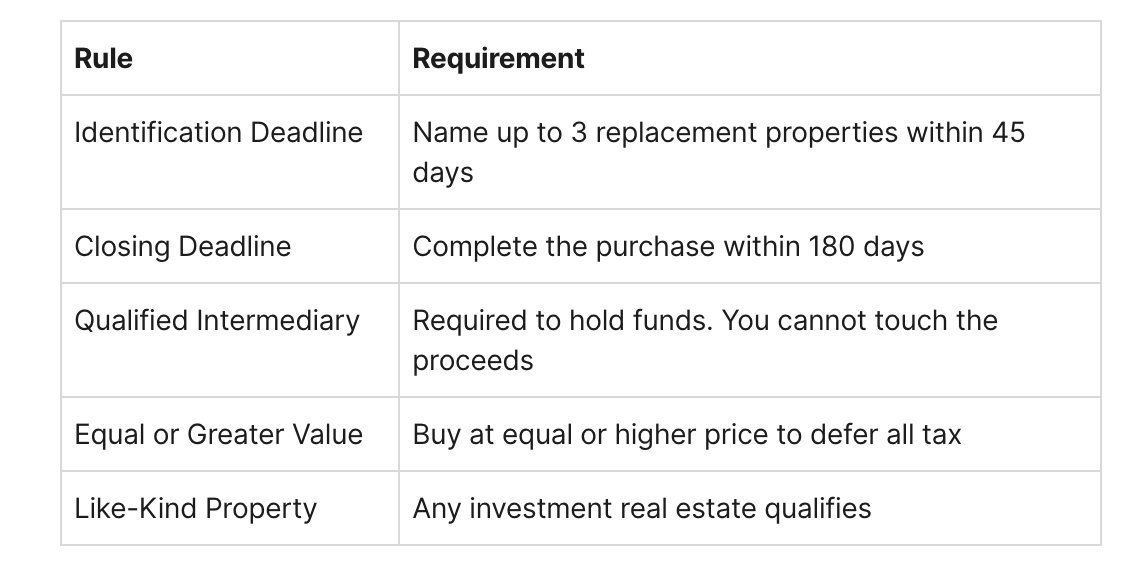
Key Rules at a Glance
One Important Step Before Selling
You will need to work through a Qualified Intermediary (QI) as this is a requirement by the IRS, making it compulsory for each 1031 exchange. After you sell, the QI will hold onto the money from the sale and pay the seller of the property that you are buying. The moment you come into contact with the funds, the exchange is considered void, and the IRS will demand the full payment of taxes immediately.
Plan Before Listing Your Property
The most appropriate time for a 1031 exchange is when listing your property for sale rather than after it has been sold. The very moment when the sale is finalized is when the 45-day deadline is triggered, and your possibilities start to shrink considerably. Collaborate with a real estate tax expert and arrange the right QI early. If done correctly, a 1031 exchange can help you expand your holdings and transfer your wealth to your heirs while minimizing taxes at each stage.