
Avoid This #1 Hidden Tax Trap in Mileage-Reimbursed Vehicles

Avoid This #1 Hidden Tax Trap in Mileage-Reimbursed Vehicles
Many workers believe that if they are fully reimbursed for work-related travel, the taxman won't come knocking. This is a big misconception. The IRS mileage rate conceals a hidden tax trap that unsuspecting workers and business owners often fall into year after year. Here's what you need to understand before you decide to sell or trade in your car.
What Is the Hidden Tax Trap in Mileage Reimbursements?
According to the IRS standard mileage rate, reimbursement is not only for gas. Quite the opposite, it comprises several expenses in one sum, including a depreciation factor.
Your Vehicle's Basis Gets Reduced Without You Knowing
One of the biggest drawbacks of reimbursing employees with IRS standard mileage rates in an accountable plan is that tax laws interpret the employees' personal cars as business cars. And since that rate includes a depreciation component, every mile reimbursed reduces the tax basis of your car even though you have never claimed depreciation on your tax return or income, including the reimbursements.
It is important because it is the moment when you sell or trade the vehicle that the reduced basis results in a higher taxable gain or a loss deduction.
A Real Example That Shows the Problem
Suppose Leo is an employee (W-2) who purchased an $85,000 car and used it solely for business. His employer reimbursed him a total of $33,304 for the miles he used the car for business during four years. Estimating some of the depreciation, $14,815 was the amount used to reduce Leo's basis in the car to $70,185. Then, when Leo exchanged the car for $47,000, the tax authorities regarded that trade as a taxable disposition.
Leo was reimbursed the full amount for each mile. However, he never considered filing any extra documentation. Nonetheless, the IRS still attributed a loss to that vehicle disposal that he had to declare on Form 4797.
Why Does the IRS Include Depreciation in the Mileage Rate?
The mileage rate includes more than just gas costs. The IRS intends the rate to represent the average operating costs of a vehicle that a business uses.
Here are some of the costs:
Gas and oil
Upkeep and repairs
Car insurance
Vehicle registration and licensing fees
Depreciation portion
The IRS rate depicts all the standard vehicle expenses that a worker utilizes while travelling to and from work. That part of depreciation lessens your tax base every year, whether or not you are aware of it.
What Happens When You Sell or Trade the Vehicle?
This is where the trap springs. Here is a quick breakdown of how the numbers shift depending on your situation.
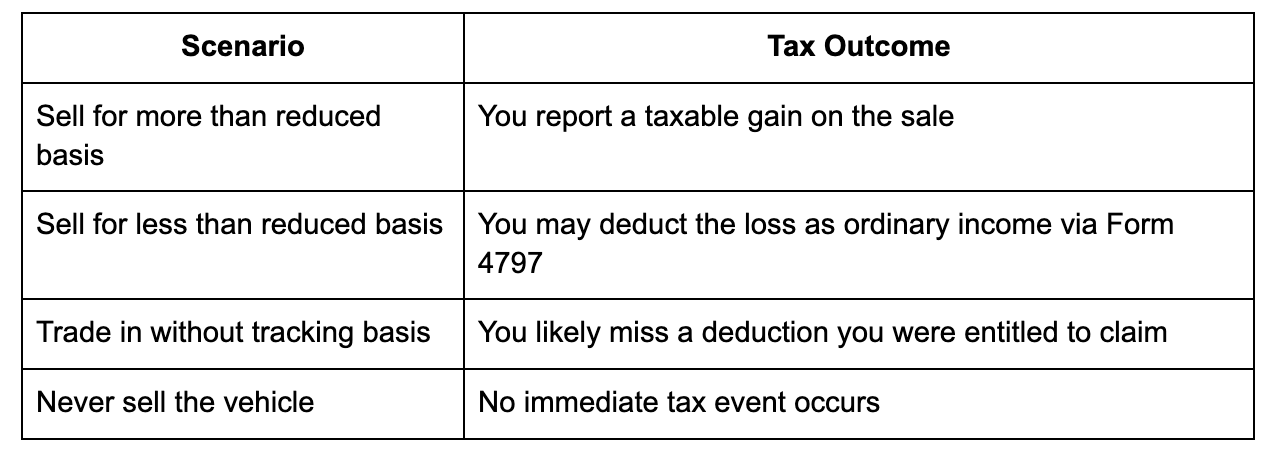
Mileage reimbursements cover current operating costs and a portion of wear and tear but they do not recover your full investment in the vehicle. When you sell or trade a mileage-reimbursed car for less than its remaining basis, the tax code allows you to deduct the unrecovered amount.
Most employees walk away from that deduction simply by not knowing it exists.
How Do You Protect Yourself?
Begin the tracking of your vehicle's adjusted basis with the very first reimbursed mile.
For that, you require:
Original vehicle purchase price
Annual total reimbursed miles
IRS yearly depreciation component is incorporated in the rate
Store these documents for as long as you use the vehicle and at least three years after you dispose of it.
Act Before Your Next Sale
If your personal vehicle use for business is reimbursed by an accountable plan, you might have a smaller tax basis than you imagine.
Consider consulting a tax professional before your sale or trade decision. The deduction or gain calculation at disposal might be significantly more lucrative than the cost of accurately obtaining it.