
Truth About When Work Clothing Is Deductible
Truth About When Work Clothing Is Deductible
Millions of workers purchase special work clothes and then simply assume they can claim the cost as a tax deduction. However, the IRS disagrees. Most of work clothes fail the deduction test even if they stayed in the office only. You can protect yourself from a declaration of your claim as invalid or a tax audit by simply knowing the exact borderline between what is deductible and what is not.
What is the IRS actually permitting you to deduct?
The IRS is not prohibiting all clothing deductions. It simply prohibits items of clothing that can double as everyday wear. That one rule alone disqualifies far more than one might think.
According to the IRS that have been in place since a long time, clothing worn for work is not tax-deductible, simply because it's work clothing. In case the clothing may be worn in public without causing a scene, then, in most cases, it will not be tax-deductible.
The Two Tests Your Clothing Must Pass
The clothing you seek to deduct has to be not only right for your work according to your employer's or your job's demands, but also something that cannot be worn outside of work in a normal way.
These two prerequisites are the only base for a successful deduction:
Your employer or job requires it
It is truly unsuitable for everyday wear outside of work
As a matter of fact, both criteria should be fulfilled simultaneously to claim a deduction. One criterion alone does not suffice.
Conditions Met of Clothing Expenses Under IRS Regulations
Deductible are only uniforms which display the company's logo or are so impersonal that they cannot be worn for personal purposes. Flight attendants, batsmen, and nurse uniforms are some instances of such clothing. Besides, employees being given safety gears are also considered as deductible.
Usually items include attire like:
Construction site safety stuff: hard hats, steel boots, goggles
Hospital scrubs that cannot be reasonably worn in public
Theatrical or performance costumes specific to a role
Company branded gear with logos such as caps and T-shirts
Mechanic overalls extensively soiled or highly specialized ones
If it turns out that the purchase of your clothing for work qualifies as a business expense, you can also deduct the costs for their upkeep. Besides cost of dry cleaning, alterations, and repairs, you can also deduct the expense for shoe polishes.
What the IRS Will Possibly Reject
Very few people have an idea of the type of things that fall into a deductible category. The list of disqualified clothing is longer than most expect.
Unfortunately, business and business casual clothes such as suits, pants, blouses, and shoes also do not qualify for a deduction. In fact, even khaki-type garments, plain shirts, everyday shoes and boots will not pass the test either. The IRS never allows a deduction for watches regardless of business use.
However, a court case makes it very obvious. A sales manager at a luxury clothing boutique was mandated to wear the merchandise working there. She deducted the expense. The IRS contested and they finally won the case by proving that the goods were appropriate for personal occasions even if the taxpayer never wore them outside the office.
Who Can Actually Claim This Deduction?
Your employment status changes everything here.
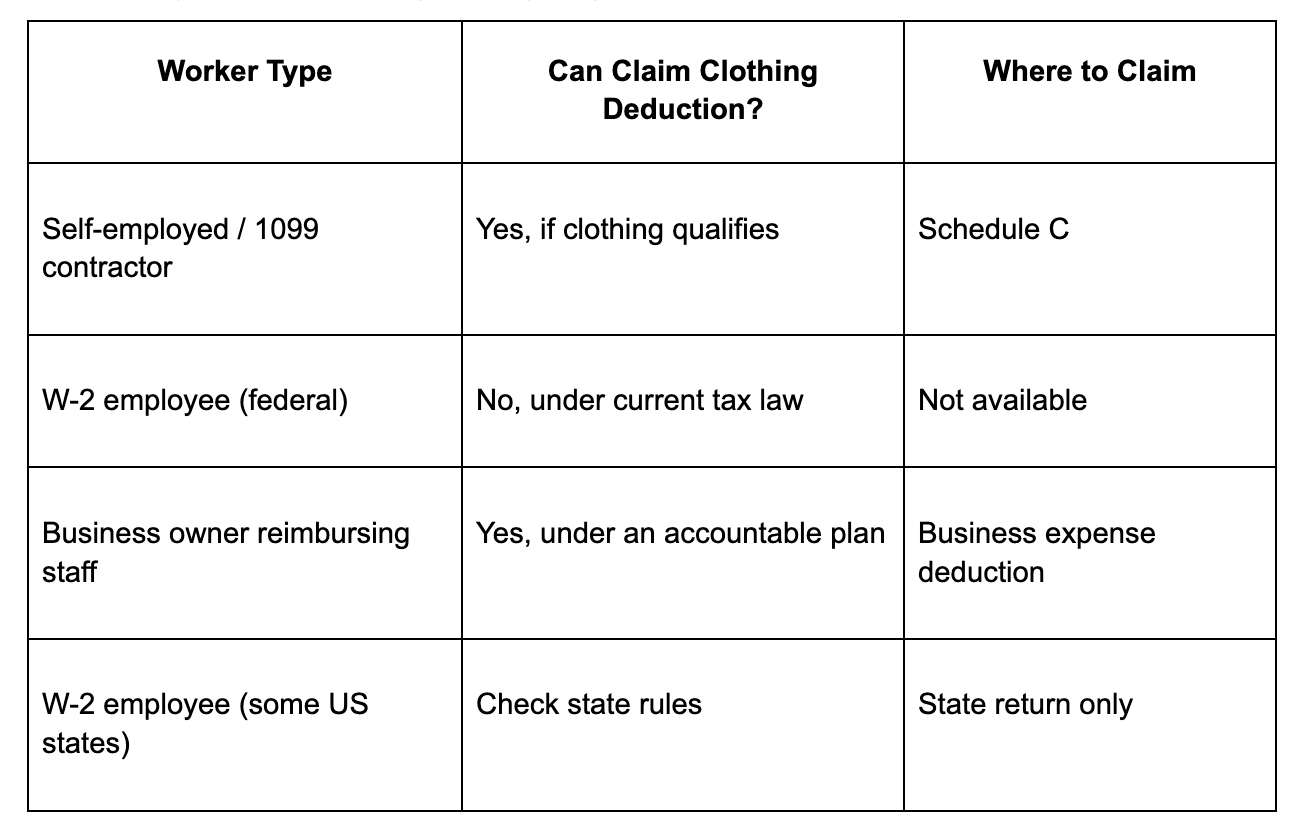
Under the federal tax system most of the time, W-2 employees will not be able to itemize deductions for unreimbursed employee expenses such as work clothing on their federal tax returns. If you are self-employed, a 1099 contractor, or own a business, these purchased items are regarded as business expenses that could be deducted on your Schedule C.
If you are a W-2 employee, consider asking your employer for a reimbursement for clothing costs that qualify under an accountable plan. This way, the reimbursement would be tax-free to you, and the employer would get the deduction.
Keep your records clean
Keep every receipt. Make a note of the reason each clothing item was necessary and why it could not be worn outside of work. The IRS may require you to prove both at any time. Proper documentation gives a clean deduction versus a denied claim.
Professionals handling tax should be contacted in advance when the intent is to claim clothing expenses. The laws are tough, and the exceptions are few. It is always less expensive to do it correctly the first time than to fix it later.